


What Is a Forehead Osteoma?
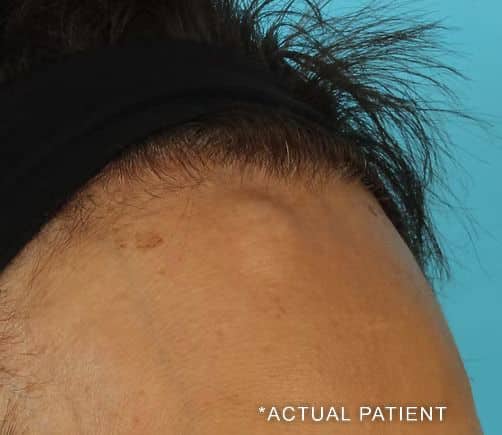
A forehead osteoma is a benign, slow-growing tumor composed of mature bone. It typically develops along the outer surface of the frontal bone, which forms the forehead, although osteomas can also occur elsewhere in the skull and facial skeleton.
Unlike soft-tissue lumps, osteomas generally feel hard, fixed, and immovable because they arise from bone rather than the skin or underlying fatty tissue.
Common characteristics of a forehead osteoma include:
- A firm, bony bump that does not move beneath the skin
- Gradual enlargement over months or years
- A rounded or raised appearance along the forehead
- Little or no pain in uncomplicated cases
- A visible difference in forehead contour or symmetry
- Occasional tenderness or pressure, depending on the location
The exact cause of many osteomas is unknown. Some have been associated with previous trauma, inflammation, or developmental factors, but these associations do not explain every case.
Most forehead osteomas are noncancerous and do not require removal for medical reasons. However, patients may choose treatment when the growth becomes cosmetically noticeable, uncomfortable, or concerning.
How Are Forehead Osteomas Diagnosed?
Not every forehead bump is an osteoma. Other conditions, including lipomas, cysts, and changes related to previous injuries, can produce similar visible concerns. During an evaluation, Dr. Shah examines the location, firmness, shape, and surrounding facial anatomy. He also reviews the patient’s medical history, how long the bump has been present, and whether it has changed over time.
Imaging, particularly a CT scan when indicated, can help establish whether the growth originates from bone, determine its size and depth, and evaluate its relationship to nearby structures.
This distinction is important because an osteoma arising from the outer forehead bone may be approached differently from one involving the frontal sinus or other deeper structures.
A new or rapidly changing forehead mass should be medically evaluated rather than assumed to be a harmless osteoma.
When Should a Forehead Osteoma Be Removed?
Because most osteomas grow slowly and remain benign, removal is not always necessary. Observation may be appropriate when a growth is small, stable, painless, and does not affect appearance or function.
Patients may consider osteoma removal when they experience:
- A prominent forehead bump that affects facial symmetry
- Increasing visibility as the growth enlarges
- Discomfort or localized pressure
- Difficulty concealing the growth with hairstyles
- Changes in forehead contour that affect confidence
- A confirmed osteoma for which removal is recommended following medical evaluation
The decision to proceed with surgery depends on more than the size of the bump. Dr. Shah considers the osteoma’s location, underlying bone structure, symptoms, imaging findings, and the patient’s goals.
For osteomas involving the sinuses, eye socket, or other deeper structures, additional evaluation or a different surgical approach may be necessary.
Who Is a Candidate for Endoscopic Osteoma Removal?
Patients who have a confirmed, accessible forehead osteoma and want to address a visible bony prominence may be candidates for endoscopic removal.
Appropriate candidates generally have a growth that can be safely reached through a concealed scalp incision, are in suitable health for an elective procedure, and understand the potential benefits and limitations of surgery.
Dr. Shah also considers scalp anatomy, hairline position, previous forehead surgery, medical conditions, and the osteoma’s relationship to nearby nerves, blood vessels, and sinus structures.
Patients with significant medical risks, an uncertain diagnosis, or a growth involving deeper anatomical structures may need additional testing, treatment planning, or an alternative surgical approach.
What Should I Expect During Osteoma Removal and Recovery?
Dr. Shah performs selected endoscopic forehead osteoma removals as outpatient procedures. According to the practice’s existing treatment information, many procedures take less than an hour, although surgical time varies with the growth’s size, location, and complexity.
Local anesthesia may be sufficient for some patients, while others require additional medication or anesthesia based on the surgical plan.
Following surgery, patients can expect some swelling, tenderness, and possible bruising around the forehead or eyes. Temporary numbness or altered sensation may also occur. Many patients undergoing uncomplicated removal may feel comfortable returning to desk work and light daily activities within one to two days.
However, swelling and healing can continue beyond that period, and more involved procedures may require additional recovery time. Patients should follow Dr. Shah’s specific instructions regarding incision care, head elevation, activity restrictions, medications, and follow-up appointments.
Why Choose Dr. Anil Shah for Endoscopic Forehead Osteoma Removal in NYC?
Removing a forehead osteoma requires more than eliminating a bony bump. The surgeon must carefully navigate the facial anatomy, protect surrounding structures, and restore a smooth, natural-looking forehead contour while minimizing visible scarring.
At Noses and Necks NYC, Dr. Anil Shah uses a minimally invasive endoscopic technique for appropriately selected osteomas. Through a small incision concealed within the hair-bearing scalp, he uses an endoscope and specialized instruments to access and remove the growth without making an incision directly over the forehead.
Dr. Shah’s qualifications and approach include:
- Double Board Certification: Certified in facial plastic surgery and otolaryngology–head and neck surgery.
- Specialized Surgical Training: Fellowship-trained in facial plastic and reconstructive surgery.
- Endoscopic Expertise: Uses camera-assisted visualization to remove suitable forehead osteomas through a concealed scalp incision.
- Attention to Facial Contour: Focuses on removing the bony prominence while preserving natural forehead proportions.
- Individualized Surgical Planning: Evaluates the osteoma’s size, location, and surrounding anatomy to determine the most appropriate surgical approach.
For suitable patients, this technique offers the potential for a smoother forehead contour, less noticeable scarring, and outpatient treatment with a relatively short recovery period. Not every osteoma can be safely removed endoscopically, and Dr. Shah determines candidacy following an examination and any necessary imaging.
FAQs About Endoscopic Forehead Bony Growth (Osteoma) Removal
Will I have a visible scar after endoscopic osteoma removal?
Dr. Shah's endoscopic approach is designed to avoid a visible incision directly on the forehead. Instead, the incision is positioned within the hair-bearing scalp, where surrounding hair can help conceal the scar.
Although this placement can make scarring less noticeable, no surgical incision is completely scarless. Scar visibility depends on incision location, hair density, skin characteristics, and individual healing.
Can a forehead osteoma grow back after removal?
Complete removal of an osteoma generally offers a low likelihood of recurrence, but regrowth is possible. The risk depends on the nature of the growth and whether it can be completely removed. Dr. Shah will explain the expected outcome and whether additional monitoring is appropriate.
What is the difference between an osteoma and an exostosis?
Both terms describe bony growths, but they are not always interchangeable.
An osteoma is a benign tumor composed of mature bone. An exostosis is a broader descriptive term for an outward-projecting bony growth, which may develop for different reasons.
The distinction may depend on the growth's location, clinical history, imaging appearance, and, when necessary, tissue examination. Dr. Shah evaluates the individual growth rather than relying on its appearance alone.
Is forehead osteoma removal medically necessary?
Not always. Many forehead osteomas are removed primarily because they create an unwanted visible bump. Removal may be medically indicated when a growth causes symptoms, affects nearby structures, or presents other clinical concerns. Osteomas involving the frontal sinus or orbital region may require more extensive evaluation.
Medical necessity and potential insurance coverage depend on the diagnosis, symptoms, treatment plan, and insurance policy.
What are the risks of endoscopic osteoma removal?
Potential risks include bleeding, infection, swelling, bruising, scarring, temporary or persistent numbness, contour irregularities, asymmetry, incomplete removal, recurrence, and complications related to anesthesia.
Injury to nearby nerves, blood vessels, or other anatomical structures is also possible. The specific risks depend on the osteoma's location and the surgical approach.
Dr. Shah will review the relevant risks and alternatives before recommending treatment.
How Much Does Forehead Osteoma Removal Cost in New York City?
The cost of osteoma removal varies according to the size and location of the growth, surgical complexity, anesthesia requirements, and whether imaging or additional treatment is needed.
Because the procedure is individualized, accurate pricing is determined following consultation and evaluation. The Noses and Necks NYC team can explain anticipated fees and available financing options.
Can I Have a Forehead Osteoma Removed Without Surgery?
There is no established cream, injectable treatment, or medication that reliably dissolves a mature forehead osteoma. Small, asymptomatic growths may simply be monitored. But surgical removal is necessary to eliminate the bony growth.
Schedule Your Virtual Forehead Osteoma Removal Consultation in New York City
A visible forehead bump does not necessarily require surgery, but an accurate diagnosis is the first step toward understanding your options. At Noses and Necks NYC, Dr. Anil Shah evaluates forehead osteomas and develops individualized treatment plans based on the growth’s location, underlying anatomy, and the patient’s concerns.
For appropriate candidates, his minimally invasive endoscopic technique offers an approach designed to remove the bony prominence while avoiding an incision directly To learn more, request a complimentary virtual consultation with Dr. Sha to discuss your concerns and potential next steps.